Fuel cells and batteries
Fuel cells and batteries are galvanic cells that play an important role in the energy transition taking place in industrialized countries (away from fossil, CO2-intensive and towards renewable energy sources).
Batteries, especially rechargeable secondary batteries (accumulators), are already making an important contribution to stabilizing power grids or supplying households, e.g. as electricity storage for regeneratively generated energy. The proportion of low-emission electric cars is also growing steadily in the automotive industry.
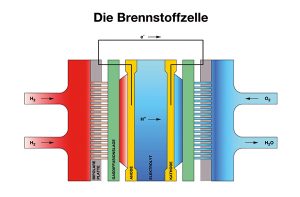
Unlike batteries, fuel cells are energy converters, not storage devices. They require a permanently supplied fuel (e.g. hydrogen or methane) to generate electricity. No CO2 is produced during direct energy generation and the advantage over accumulators is that the cell does not need to be recharged as long as fuel is available. Current applications for fuel cells include supplying heat and energy to buildings, operating off-grid devices (e.g. measuring stations) and powering very large vehicles (ships, trains).
Investment in both battery and fuel cell development is currently enormous: for batteries, research is currently focusing primarily on lifespan, energy density and charging behavior, while for fuel cells it is efficiency (catalyst effect). For both type of cell, the starting materials (electrode components, membrane materials and electrolytes) and their processing during the cell production process are particularly influential factors. This is precisely where we, 3P Instruments, offer suitable analytical measurement methods for determining important electrochemical and physical influencing parameters in order to optimize the manufacturing process and properties of the final galvanic cell.